 PocketSEO
Parasite SEO: How to rank on page one using Medium

Hridoy Reh @hridoyreh
Reviewed Jul 2026
Key Takeaway
Parasite SEO involves publishing keyword-targeted content on high-authority platforms like Medium, then linking back to your own site. Because Medium has a Domain Rating of 93, its content can rank on page one for low-competition keywords far faster than a new domain could. The method works when you choose long-tail keywords with low difficulty, write genuinely useful content, include a natural link to your site, and build 2-3 backlinks to the Medium article itself.
What is parasite SEO and why does it still work?
Parasite SEO means publishing content on a high-authority third-party platform — like Medium — and letting that domain's authority do the heavy lifting to rank your content. Google trusts Medium. You borrow that trust.
This isn't a loophole that's about to close. It's a legitimate tactic that's been working for years, and it still delivers results when you execute it properly.
How does the Medium parasite SEO method work?
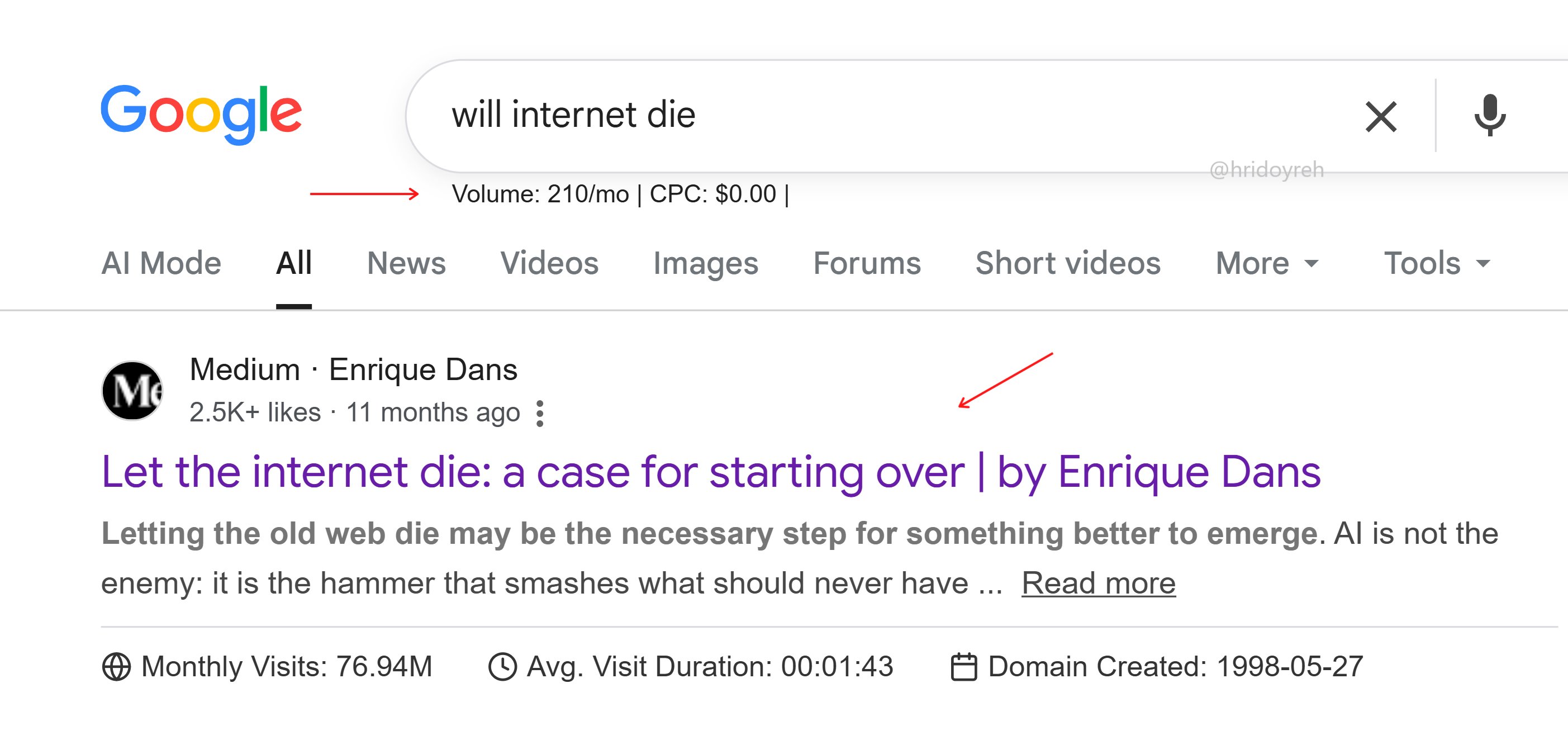
The core process is straightforward:
- Find a low-competition keyword with clear search intent — think long-tail phrases with a keyword difficulty below 20 in Ahrefs or Semrush
- Write a focused, genuinely useful article on Medium targeting that keyword
- Include a natural link back to your main website within the content
- Build 2-3 backlinks pointing at your Medium article from relevant, decent-authority sources
- Watch the Medium article rank on page one, which drives referral traffic to your site
The logic is simple: ranking a Medium article is far easier than ranking a brand-new domain. According to Ahrefs, Medium has a Domain Rating of 93 — competing against that as a fresh site is nearly impossible for most keywords. Riding it isn't.
What does "doing it correctly" actually mean?
This is where most people trip up. Here's what separates the attempts that work from the ones that don't:
Pick the right keyword. Don't go after anything with high competition. The whole point is that Medium's authority covers the gap. You're looking for keywords where the top results are thin forum posts, weak directories, or low-DR blogs — not established brands.
Write real content. Google's quality raters can evaluate Medium articles. A 300-word filler piece won't hold a top ranking. Aim for something that answers the query completely — usually 600-1200 words depending on the topic.
Link naturally. One contextual link to your site works. Stuffing multiple links or making the article feel like a landing page will hurt both the article's ranking and your site's association with it.
Build links to the Medium article, not just your site. This is what most people skip. Two or three backlinks from relevant blogs or resource pages pointing at your Medium article is often enough to push it to page one for a low-competition keyword.
Track the referral traffic. Set up UTM parameters on your link back to your main site so you can measure how much traffic is actually flowing through. If the Medium article ranks but nobody clicks through, the anchor text and call-to-action in your article need work.
Which keywords are worth targeting this way?
Good candidates for parasite SEO on Medium:
- Informational queries your site doesn't have the authority to rank for yet
- Niche how-to questions with 100-1,000 monthly searches
- Keywords where competitors ranking are forums, Quora pages, or low-authority blogs
- Brand-adjacent topics you want to own before a competitor does
Avoid transactional keywords with heavy competition. Parasite SEO isn't a substitute for building your own domain authority — it's a way to capture traffic while you do.
Want the full playbook? Read our guide on Image Backlinks: The Underrated Link-Building Play for 2026.