 PocketSEO
How to spot low-competition keywords before you waste 6 months

Keval Shah @SEOKeval
Ecom SEO + AI SEO
Reviewed Jul 2026
Key Takeaway
To find low-competition keywords, search the term in Ahrefs, open the SERP view, and look for pages ranking in the top 5 with a Domain Rating under 40 that don't have the keyword in their domain name. A page meeting both conditions is a weak page — and weak pages can be outranked. Once you find one, optimize your page for the keyword, build a few relevant backlinks to it, and add internal links. With 3-6 months of consistent effort, you can take that top-5 spot.
Why does a weak page ranking in the top 5 matter?
If a low-authority page already ranks in the top 5 for a keyword, that's a signal the keyword has a soft ceiling. You don't need to outrank Forbes or a site with thousands of backlinks — you just need to be better than the weakest page currently holding a top spot.
This single check can save you months of effort on keywords you have no realistic shot at winning.
How do you identify a weak ranking page?
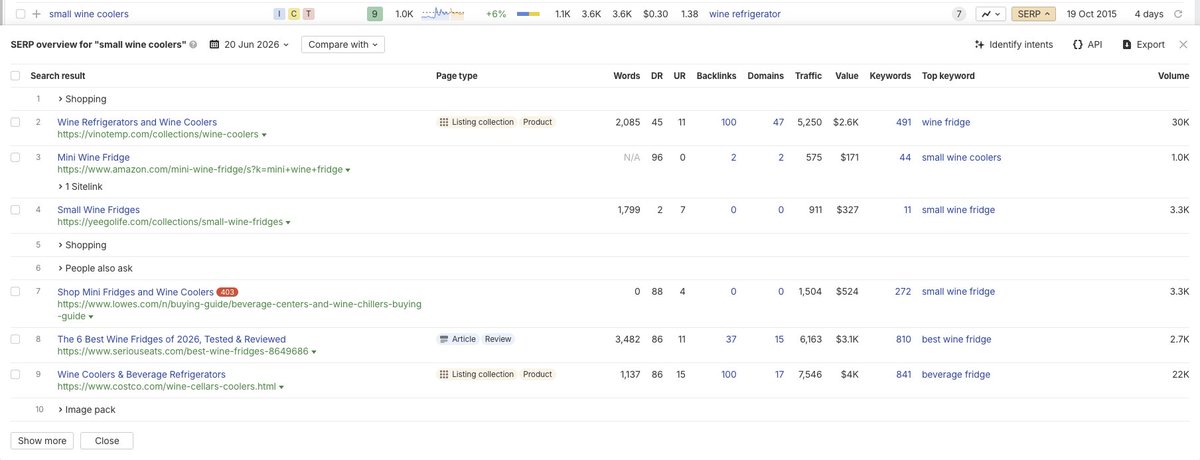
The method is straightforward. Open Ahrefs (or a similar tool with SERP data), search your target keyword, then click the SERP button to see which pages currently rank for it.
Look for pages in positions 1-5 that meet both of these conditions:
- Domain Rating (DR) under 40
- The keyword does not appear in their domain name
The second condition matters because domains with an exact-match or partial-match keyword in their URL often get a ranking boost that has nothing to do with their content quality or backlink profile. Exclude those and you're looking at a genuinely weak page.
If you find even one page that fits both criteria sitting in the top 5, that's your green light.
What do you do once you find a weak page?
Spot a weak page? Here's what to do next:
- Optimize your page for the keyword. Make sure the keyword appears in your title tag, H1, first paragraph, and a few subheadings. Don't stuff it — use it where it reads naturally.
- Build backlinks to that specific page. A handful of relevant, quality links can be enough to push past a DR 30-40 page. According to Backlinko's analysis of 11.8 million search results, the #1 result has an average of 3.8x more backlinks than pages in positions #2-#10.
- Add internal links pointing to it. Find other pages on your site that mention the topic and link them to this page. Internal links pass authority and help Google understand the page's relevance.
Give it 3-6 months. A page with decent on-page optimization, a few solid backlinks, and internal link support can realistically displace a weak DR 30 page sitting in position 4 or 5.
Is DR the only signal worth checking?
DR is a quick proxy, but check a couple of other things while you're in the SERP view:
- Page-level backlinks: A low-DR domain might still have a page with 200 backlinks. That's harder to beat than a DR 35 site with 4 links to the ranking page.
- Content quality: Skim the ranking page. If it's thin, outdated, or off-topic, that's another sign you can take the spot with something better.
- Search volume: A low-competition keyword with 50 monthly searches still moves the needle for a small site. Don't skip low-volume keywords — they often convert better than broad terms.
This SERP check takes about 5 minutes per keyword. Run it before you commit to writing anything, and you'll stop burning time on keywords that are effectively locked up by authoritative sites.
Want the full playbook? Read our guide on 5 SaaS Page Types That Actually Drive Organic Traffic.