 PocketSEO
The Complete Guide to Advanced Claude SEO Prompting
Stop getting generic SEO advice and start getting results with proper Claude prompting techniques.
Last updated: May 2026
Why Most People Get Terrible SEO Advice from Claude
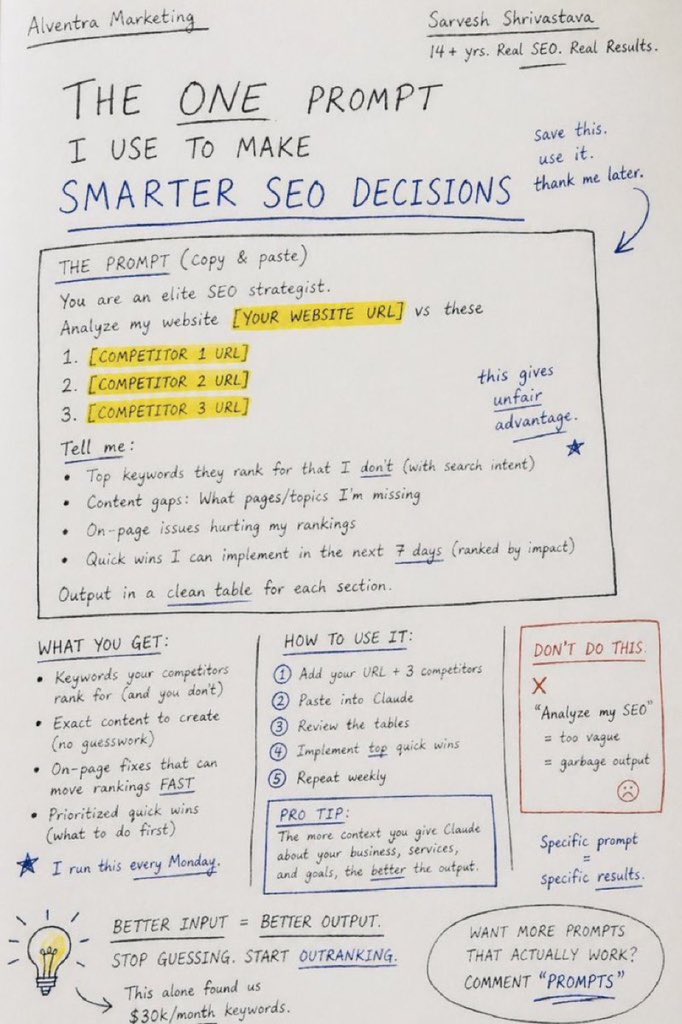
Most business owners approach Claude like this: "Fix my SEO" or "Write me a blog post that ranks." The result? Generic advice that could apply to any business anywhere.
The problem isn't Claude. It's how you're using it.
When you give Claude no context about your business, competitors, or market, it defaults to textbook SEO advice. That's not strategy - it's guessing.
The businesses getting real results from Claude follow a specific setup process that transforms Claude from a generic AI tool into a specialized SEO strategist for their exact business and market.
Setting Up Your Business Brain in Claude
Before you ask Claude anything about SEO, you need to load your business context. This step alone separates the businesses that get results from those that waste months spinning their wheels.
Here's the exact prompt to use:
Here is everything you need to know about my business:

[Business name], [website URL], [city/location], [main services], [target cities], [top 3 competitor URLs].

Use this as context for everything. Never ask me for this again.
Fill in each bracket with your specific information. For example:
"Here is everything you need to know about my business: Mike's Plumbing, mikesplumbing.com, Austin Texas, emergency plumbing and drain cleaning, Austin/Round Rock/Cedar Park, [competitor1.com, competitor2.com, competitor3.com]. Use this as context for everything. Never ask me for this again."
This transforms Claude from giving advice that could apply to any plumber anywhere into giving advice specifically for a plumbing business competing in the Austin market against those exact competitors.
Choosing the Right Claude Model and Settings
Most people run SEO prompts on the default Claude model. This is where they lose before they even start.
Here's the correct setup:
- Open Claude through Cowork (not the regular chat interface)
- Select Opus 4.7 as your model
- Turn on Extended Thinking
Why does this matter? The default models give surface-level responses. Opus 4.7 with Extended Thinking actually analyzes your market, thinks through competitor positioning, and considers multiple SEO angles before responding.
The difference in output quality is dramatic. You'll go from getting advice like "create good content" to getting specific recommendations like "target 'emergency plumber Cedar Park' because your competitor ranks #3 for this keyword but has only 12 reviews compared to your 47."
Creating Global SEO Instructions
Instead of explaining what you want Claude to do in every single prompt, set up global instructions once that run automatically in every session.
Go to Settings → Cowork → Edit Global Instructions and paste this:
You are my local SEO strategist with 14 years of experience. Always read my business context before responding. Always compare my business against my competitors before giving advice. Always prioritize recommendations by revenue impact. Never give generic SEO advice that doesn't apply to my specific market and location.Now every time you ask Claude an SEO question, it automatically:
- References your business context
- Considers your competitors
- Focuses on revenue-generating recommendations
- Avoids generic advice
Your prompts can now be as simple as "audit my homepage" and Claude will deliver a comprehensive competitive analysis instead of generic best practices.
Building Your Competitor Intelligence File
Create a document called COMPETITORS.md with detailed intelligence on your top 5 competitors. Include:
For each competitor:
- Website URL
- Google Business Profile URL
- Review count and average rating
- Keywords they rank for that you don't (use Ahrefs or SEMrush)
- Google Business categories they have that you're missing
- Their top-performing content topics
- Their backlink profile strength
Example entry:
Competitor: Austin Emergency Plumbing
Website: austinplumbers.com
GBP: google.com/maps/place/austin-emergency-plumbing
Reviews: 89 reviews, 4.2 stars
Keywords they rank for: "plumber near me austin" (#2), "emergency plumber south austin" (#1)
Missing categories: Septic tank service, Water heater installation
Top content: "How to fix a burst pipe" (2.3K monthly visits)
Paste this competitor file into Claude before every SEO session. Now Claude knows exactly who you're competing against and can make recommendations specifically designed to outrank these businesses.
Setting Up Your Keyword Intent Filter
Most keyword research returns a mix of informational and commercial keywords. For local businesses, you only want commercial intent keywords - terms that indicate someone is ready to hire you.
Before any keyword research session, tell Claude:
Only give me keywords with clear buyer intent. Ignore informational keywords. Focus only on service + city, emergency + service, and "near me" combinations. Every keyword you suggest must indicate someone who is ready to call or book today.This filter eliminates 90% of wasted SEO effort. Instead of targeting "how to fix a leaky faucet" (informational), you'll focus on "emergency plumber Austin" (commercial intent).
Advanced Prompting Techniques for Specific SEO Tasks
Homepage Audit Prompt
Audit my homepage against my top 3 competitors. Identify specific elements they have that I'm missing, keywords they're targeting that I should target, and technical improvements that will directly impact my local search rankings.Content Gap Analysis
Analyze my competitors' content and identify 5 high-commercial-intent topics I should create content about. For each topic, provide the target keyword, estimated search volume in my market, and why this content will drive revenue.Local SEO Priority List
Create a prioritized action plan for improving my local SEO rankings. List each action by potential revenue impact and implementation difficulty. Focus on changes that will move the needle in the next 30 days.Google Business Profile Optimization
Compare my Google Business Profile to my competitors and identify specific optimizations that will improve my local pack rankings. Include category additions, attribute updates, and content recommendations.Pre-Session Checklist
Before every Claude SEO session, verify:
- [ ] Am I in Cowork (not regular Chat)?
- [ ] Is Opus 4.7 + Extended Thinking selected?
- [ ] Did Claude read my business context?
- [ ] Is my competitor file loaded?
- [ ] Is my keyword intent filter set?
Get all five elements right before running any prompts. This setup is the difference between generic advice and market-specific strategy.
Common Mistakes to Avoid
Using the wrong model: Running SEO prompts on Sonnet or basic Claude gives surface-level results. Always use Opus 4.7 with Extended Thinking.
Skipping business context: Without your business details, Claude defaults to generic advice that applies to any business anywhere.
Ignoring competitors: SEO is competitive. If Claude doesn't know who you're competing against, its recommendations won't be strategic.
Accepting informational keywords: Local businesses need commercial intent keywords. Don't waste time on "how to" content unless it directly drives calls.
Inconsistent setup: If you don't set global instructions, you'll spend time re-explaining your requirements in every session.
Measuring Your Results
Track these metrics to measure the impact of your improved Claude prompting:
Local search rankings: Monitor positions for your target commercial keywords in your service area.
Google Business Profile views: Increased visibility should drive more profile views.
Website traffic from local searches: Use Google Analytics to track organic traffic from location-based keywords.
Phone calls and form submissions: The ultimate measure - are you getting more qualified leads?
Review velocity: Better local SEO often correlates with increased review generation.
Most businesses that implement this Claude setup see measurable improvements within 30-60 days. The key is consistency - use the same setup process for every SEO session to build momentum over time.
Businesses that skip this setup continue getting generic advice and wonder why their SEO efforts aren't moving the needle. The ones that implement it properly often outrank competitors who have been established for years.
 Get the weekly SEO digest