 PocketSEO
9 AI-era SEO tactics that didn't exist (or matter) before LLMs

Cyrus SEO @CyrusShepard
Reviewed Jul 2026
Key Takeaway
Google claims good SEO equals good GEO, but the reverse isn't always true. AI-era search has introduced tactics — citation gap analysis, entity consistency, AI crawler auditing, fan-out query optimization — that predate LLMs in name only. Not all of them benefit traditional SEO equally. Solo founders should prioritize making facts explicit and ensuring entity consistency across the web, as these improve both organic rankings and AI citation likelihood simultaneously.
Does 'good SEO is good GEO' actually hold up?
Google's line that good SEO automatically equals good GEO (generative engine optimization) sounds reassuring. The problem is it only works one way. Plenty of things SEOs do specifically for AI visibility would never have made the priority list in a pre-LLM world.
That's not a criticism — search has changed, and the tactics have changed with it. But it's worth naming what's actually new so you can decide what's worth your time.
What are SEOs doing differently because of AI search?
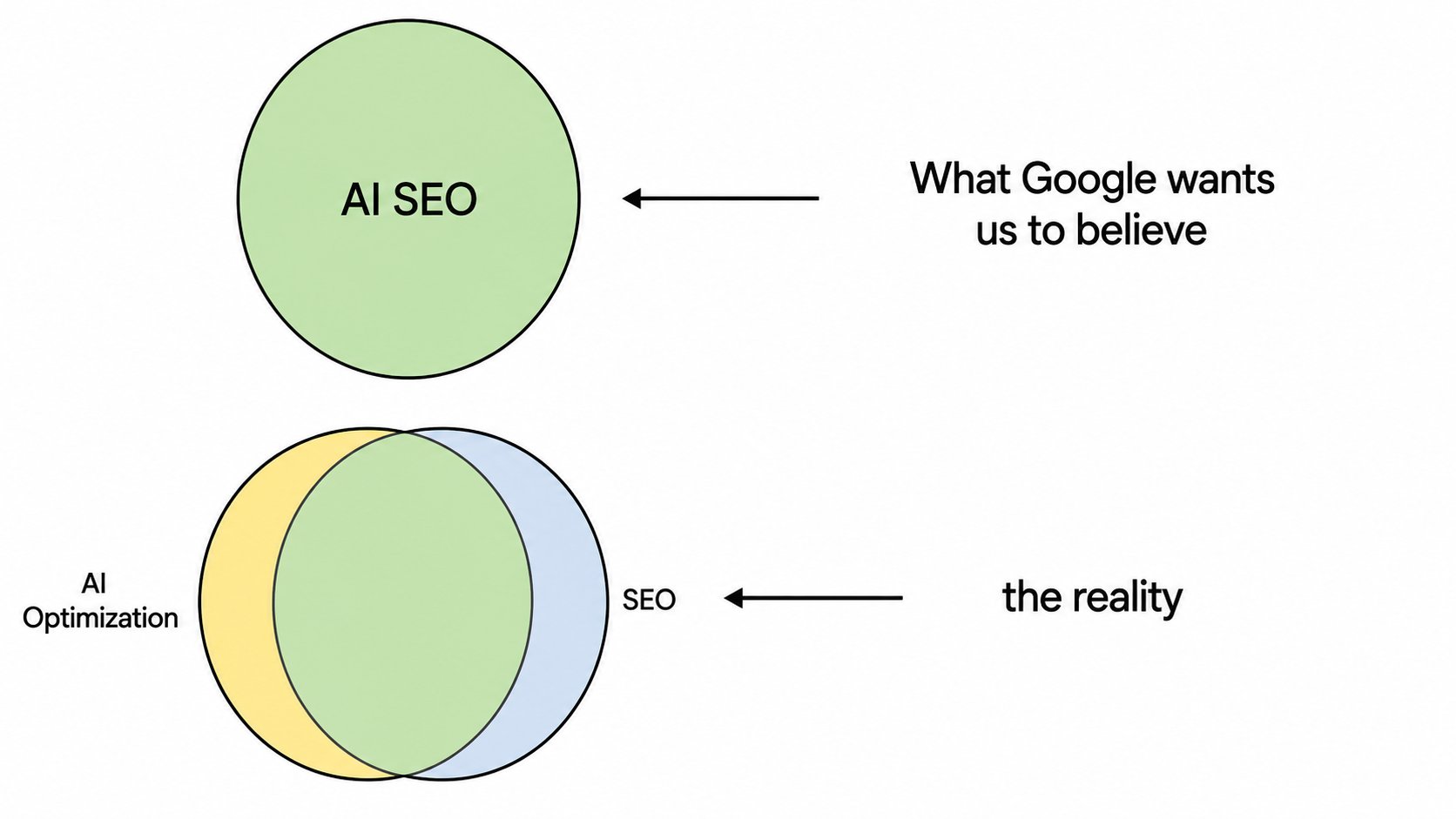
Here's a honest list of tactics that have either appeared or grown significantly in importance since AI overviews and LLM-powered search became mainstream:
- AI visibility tracking — monitoring whether your brand or content appears in ChatGPT, Perplexity, Google AI Overviews, and similar surfaces
- Citation gap analysis — finding topics where competitors get cited by AI and you don't
- Building agent-ready sites — structuring content so AI agents can read, parse, and act on it without friction
- Optimizing for fan-out queries — targeting the sub-questions an AI might generate when answering a broader query
- Publishing YouTube transcripts — making video content readable and indexable for LLM training and retrieval
- Auditing AI crawler access — checking robots.txt and bot controls to decide which AI crawlers can access your site
- Making facts explicit — stating specific claims, numbers, and attributions plainly rather than burying them in prose
- Entity consistency — ensuring your brand, people, and products are described the same way across every platform so AI models build a coherent picture
- Listicles — structured list content that AI systems can easily extract and cite
Are all of these good for traditional SEO? Mostly, but not entirely. Listicles, for example, have always had mixed results for organic traffic depending on the topic and intent.
Which of these should you actually prioritize?
If you're a solo founder or small team, you can't do all nine. Here's how to think about it:
- Start with facts and entity consistency. These improve both traditional SEO and AI visibility at once.
- Audit AI crawler access. This takes under an hour and gives you control over who's training on your content.
- Citation gap analysis is worth doing quarterly if you're in a competitive space. Free tools like Perplexity and ChatGPT let you manually check who's getting cited for your target queries.
- YouTube transcripts are a quick win if you already produce video content.
AI visibility tracking and fan-out optimization are more advanced and require dedicated tooling or significant manual effort — save those for when the basics are solid.
Should you take Google's advice at face value?
Google's guidance is worth reading, but remember the context it comes from. Google's primary business is ad revenue. Advice that keeps you publishing more content, spending more time on their platforms, and relying on their tools isn't neutral counsel.
That doesn't mean the advice is wrong. It means you should ask whether a tactic serves your audience and your business, not just whether Google endorses it.
Pay attention to new search surfaces. Test what actually drives traffic and citations to your site. And treat any single source of SEO guidance — including Google's own documentation — as one input among several.
Want the full playbook? Read our guide on AI SEO Workflows That Move Rankings: A 2026 Field Guide.