 PocketSEO
AI-Assisted Blog Writing: A Workflow for Rankable Drafts
Google doesn't penalize AI content — it penalizes thin content. Here's how to tell the difference.
Last updated: July 3, 2026

Nick Zviadadze 🇺🇦 @Nick_zv_ on Twitter/X
Jun 30, 2026 · 8d ago
Updated July 3, 2026
TL;DR
- Google's spam policies target low-quality content, not AI-generated content specifically
- AI-written pages rank all the time — the issue is how most people use AI tools
- A structured human-in-the-loop workflow separates ranking content from content that gets ignored
- The steps below are based on ranking 200+ AI-assisted pages in competitive niches
What Google actually penalizes
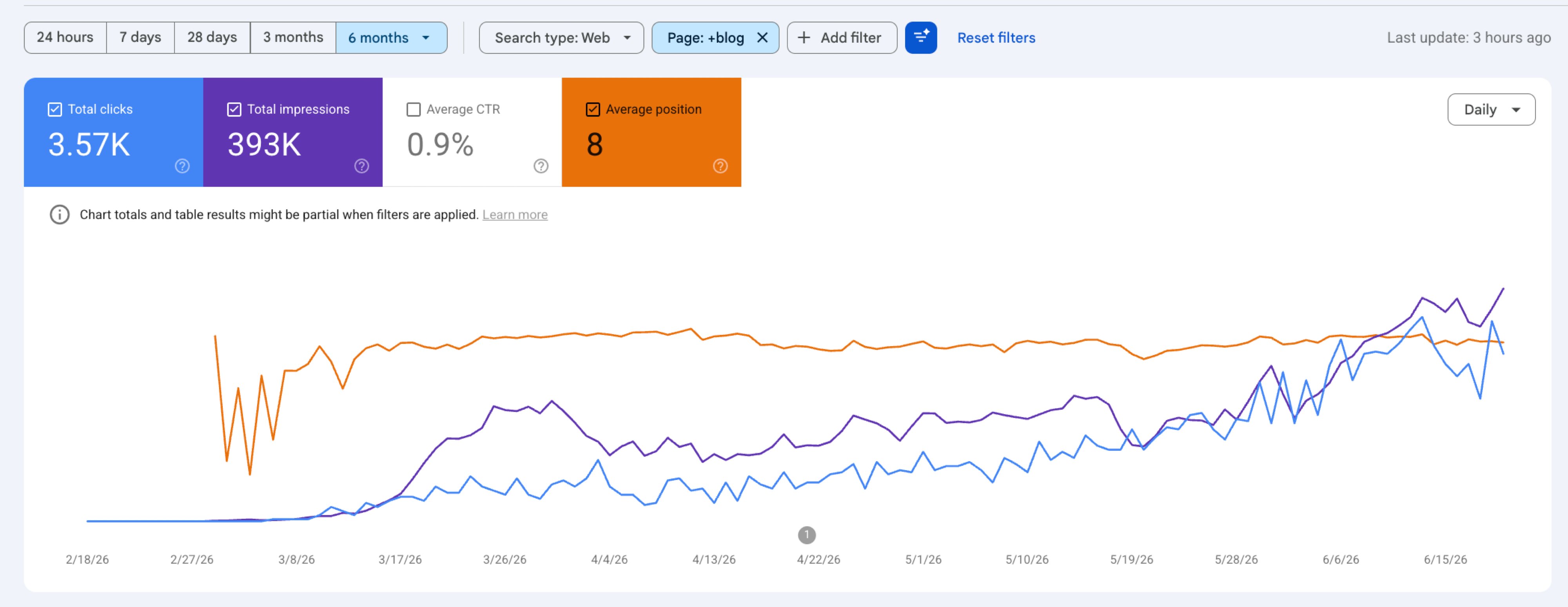
Google's helpful content system targets pages that exist to rank, not to help readers. The AI angle is a red herring. A 2,000-word ChatGPT dump with no original perspective, no real examples, and no editing fails the same test as a 2,000-word human-written article that does the same thing.
Google's own documentation says its systems aim to reward content that "demonstrates expertise, experience, authoritativeness, and trustworthiness." None of those qualities are exclusive to human writers. None of them come automatically from AI either.
According to Ahrefs, 96.55% of pages get zero organic traffic from Google. That stat predates the AI content explosion. The problem has always been quality, not origin.
So when people say "Google penalizes AI content," what they usually mean is: they published a raw ChatGPT output and it didn't rank. That's a production problem, not a policy problem.
Why raw AI output fails
Before getting into the workflow, it helps to understand exactly where unedited AI content breaks down.
It lacks specificity. AI models are trained on broad web data. When you ask ChatGPT to write about "email marketing for SaaS," it produces something that could apply to any industry in any year. Generic answers don't satisfy specific search intent.
It has no real experience. Google's E-E-A-T guidelines added an extra "E" for experience in 2022. A page about "best hiking boots" written by someone who has worn three pairs and hiked a specific trail carries more credibility signals than a page that summarizes hiking boot categories.
It repeats structure. Raw AI output has tells: the three-point intro, the "in conclusion" outro, the repetition of the target keyword every other paragraph. Readers notice. Search engines increasingly do too.
It hallucinates facts. AI models invent statistics, misattribute quotes, and describe products that don't exist. Publishing those errors is a fast way to destroy trust.
The workflow for AI-assisted content that ranks
This is the process behind 200+ ranked AI-assisted pages. It treats AI as a drafting assistant, not a replacement for editorial judgment.
Step 1: Do the keyword and intent research yourself
Before touching an AI tool, get clear on:
- The exact query you're targeting
- What type of content ranks (how-to, listicle, comparison, etc.)
- What the top-ranking pages cover and where they fall short
- What a real reader needs after landing on this page
For this step, tools like Ahrefs, Semrush, or even a careful manual SERP review give you more useful signal than anything AI can produce on its own. Our guide on [keyword research for small businesses] covers how to do this without an enterprise budget.
The output of this step is a brief: the target keyword, the search intent, the content format, the gaps to fill, and any specific claims or examples you want included.
Step 2: Build a structured prompt, not a one-liner
Most people type "write a blog about X" and publish what comes back. That's where the quality gap starts.
A structured prompt includes:
- The target audience and their specific problem
- The content format and approximate length
- Specific sections you want covered
- Tone guidance (conversational, technical, neutral)
- Anything to avoid (generic advice, filler phrases, vague claims)
- Any facts, quotes, or examples you want included
Example: "Write a 1,500-word how-to guide for solo founders who want to set up Google Search Console for the first time. Include a section on verifying domain ownership, setting up sitemaps, and reading the performance report. Use plain language. Avoid marketing fluff. Do not fabricate statistics."
The more specific the input, the more usable the output.
Step 3: Add your original layer
This is the step most people skip. It's also the most important one.
After the AI produces a draft, go through it and add:
- Personal or client examples. "We tried X and saw Y result" beats any generic claim.
- Specific data points from named sources. Find the actual study, link to it, quote the number accurately.
- Opinions. Take a position. Agree or disagree with conventional wisdom. Explain why.
- Context the AI couldn't have. Recent product updates, industry shifts, things you've observed that aren't documented online yet.
This layer is what separates a page that reads like content from a page that reads like something written by someone who knows their subject.
According to a BrightEdge study, organic search drives 53% of all website traffic. That traffic goes to pages that answer questions better than competing pages. Original experience and specific examples are the fastest way to do that.
Step 4: Edit for quality, not just grammar
Editing AI output is different from editing human writing. The common issues are:
- Redundancy (AI restates the same point three times in different words)
- Vagueness ("many businesses find that" — which businesses, what did they find?)
- Hollow transitions ("it's worth noting that," "importantly," "furthermore")
- Padding (sections that exist to hit a word count target, not to add information)
Cut ruthlessly. A 1,200-word article with no filler outperforms a 2,000-word article that makes readers scroll through three paragraphs to find one useful sentence.
Also check every factual claim. If the AI cited a statistic, find the original source. If you can't verify it, cut it.
Step 5: Format for both readers and search engines
Formatting matters because it affects whether people read the page and whether Google extracts information from it for featured snippets.
Practical formatting rules:
- Use descriptive H2 and H3 headings that reflect the actual content of each section
- Keep paragraphs to 3-4 sentences maximum for web reading
- Use numbered lists for sequential steps, bullet points for unordered collections
- Put the most important information first in each section (inverted pyramid structure)
- Include a clear answer to the target question within the first 100 words of the page
For more on this, see our guide on [on-page SEO fundamentals for small business owners].
Step 6: Add the signals that build trust
Before publishing, check that the page has:
- An author bio with genuine credentials or experience
- At least one internal link to a related page on your site
- External links to authoritative sources where you cite data
- A publish date and, where relevant, a last-updated date
- Schema markup if appropriate (how-to, FAQ, article)
These aren't tricks. They're the signals that tell both readers and search engines that a real person with real knowledge produced this page.
Common mistakes that kill AI-assisted content
Publishing without a subject-matter review. If you're writing for an industry you don't know well, have someone with domain expertise read the draft before it goes live. AI confidently produces wrong answers in specialized fields.
Using AI for thin-content plays. Generating 50 short articles targeting long-tail variants of the same keyword used to work. Google's helpful content updates have made this increasingly unreliable. Depth beats volume.
Ignoring the competition. If the top three results for your target keyword are 3,000-word guides with detailed examples and you publish a 700-word AI summary, the length difference is the least of your problems. Match and exceed the quality of what's already ranking.
Over-relying on one AI tool. Different models have different strengths. ChatGPT, Claude, and Gemini produce meaningfully different output on the same prompt. Testing a few options on a draft often surfaces better raw material to work with.
According to Semrush's 2023 State of Content Marketing report, long-form content (3,000+ words) gets three times more traffic than average-length articles. That's not an argument for padding — it's an argument for covering topics thoroughly.
How to know if your AI content is good enough to publish
Before publishing any AI-assisted page, answer these questions:
- Does this page answer the target query better than the current top results?
- Does it contain at least one piece of information a reader couldn't easily find elsewhere?
- Has every factual claim been verified?
- Has a human read it and found it genuinely useful?
- Would you be comfortable putting your name on it?
If any answer is no, the page isn't ready. That's the standard, regardless of whether a human or an AI wrote the first draft.
For a broader look at how to build content that earns traffic over time, see our guide on [content strategy for solo founders].
FAQ
Does Google know if content was written by AI? Google's public position is that it doesn't try to detect AI authorship. Its systems assess quality signals: expertise, accuracy, depth, and user satisfaction. AI-written pages that meet those standards rank. Pages that don't, won't.
How much editing does AI content need before publishing? Plan for 30-60 minutes of editing per 1,000 words of AI output. That includes adding original examples, verifying facts, cutting redundancy, and adjusting tone. Treating AI output as a first draft rather than a final product is the key distinction.
Can AI content rank for competitive keywords? Yes, but not without the original experience layer and thorough editing described in this guide. Competitive SERPs require content that earns trust signals over time: backlinks, user engagement, and consistent updates. AI can help produce the content; it can't replace the authority-building work.
What AI tools work best for blog writing? ChatGPT (GPT-4), Claude, and Gemini are the most commonly used. For SEO-focused workflows, tools like Surfer SEO and Clearscope help align AI drafts with topical coverage benchmarks. No single tool is best for all content types.
Is AI content against Google's terms of service? No. Google's spam policies prohibit content generated at scale to manipulate rankings, but they don't prohibit AI-assisted writing. The distinction is intent and quality. Helpful, accurate, well-edited AI-assisted content is explicitly not a policy violation per Google's own guidelines.