 PocketSEO
AI Content Generation at Scale: What Actually Works in 2026
Turn $20 into thousands of SEO-optimized articles using proven automation strategies.
Last updated: June 2026

Ian @keywordian on Twitter/X
Jun 6, 2026 · 16d ago
Updated June 2026
The Economics of AI Content Generation
The content creation game has fundamentally changed. What used to cost $40,000 and months of work can now be done for under $20 in a few hours. This isn't about replacing human creativity—it's about scaling content that follows proven patterns and structures.
The key insight is identifying content types that work well with AI automation. "Definition" articles, how-to guides with similar structures, and informational content about products or concepts are perfect candidates. These follow predictable patterns that AI can execute consistently.

Setting Up Your Content Template
Before generating thousands of articles, you need a bulletproof template. This isn't about creating one article—it's about creating a system that works for hundreds.
Define Your Content Pattern
Start with a content type that scales naturally:
- Product definitions and explanations
- "What is [X]" informational articles
- Step-by-step guides with similar structures
- Comparison articles following the same format
The example case used "definition of ___" articles. Each article covers a different topic but follows identical structure and requirements.
Create Your Master Prompt
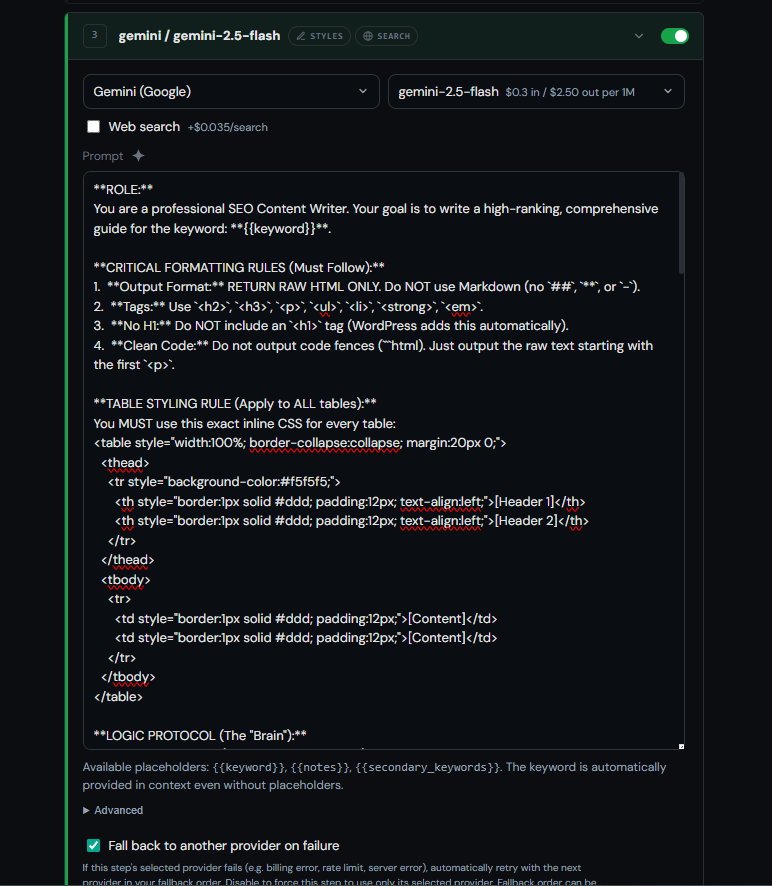
Your prompt becomes the blueprint for consistency. A well-crafted 700+ word prompt should include:
Structure Requirements:
- Exact heading hierarchy (H1, H2, H3)
- Word count targets for each section
- Required elements (intro, body, conclusion, FAQ)
Content Guidelines:
- Tone and style specifications
- What to include/exclude for different keyword types
- SEO requirements (keyword placement, density)
Quality Standards:
- Fact-checking requirements
- Source citation rules
- Originality benchmarks
Test your prompt on 10-20 articles manually before scaling. Refine until the output quality is consistently acceptable.
Choosing the Right AI Model
Not all AI models are created equal for bulk content generation. The example used Gemini 2.5 Flash, which offers an excellent balance of quality, speed, and cost.
Model Comparison for Scale:
Gemini 2.5 Flash:
- Cost: ~$0.02 per 1,500-word article
- Speed: Very fast
- Quality: Good for informational content
GPT-4o Mini:
- Cost: ~$0.05 per article
- Speed: Fast
- Quality: Better reasoning, higher cost
Claude 3.5 Haiku:
- Cost: ~$0.03 per article
- Speed: Fast
- Quality: Good balance
For 1,000+ articles, even small cost differences matter. Test quality across models with your specific prompt before committing to volume.
Automation Tools and Workflows
Manual copy-pasting 1,000 articles isn't realistic. You need automation that handles:
- Content generation
- Image creation
- WordPress publishing
- Internal linking
- Scheduling
Platform Options:
Publish Owl (Used in Example):
- Custom workflow builder
- Direct WordPress integration
- Automatic internal linking
- Image template system
- Scheduling features
Alternatives:
- Writesonic with Zapier integration
- Jasper with custom workflows
- Custom Python scripts with OpenAI API
The key is finding a platform that handles your entire workflow end-to-end, not just content generation.
Featured Image Generation Without Stock Photos
Stock photos scream "AI content" to users. The solution is template-based image generation using your brand elements.
Creating Image Templates:
-
Design a Base Template:
- Use your brand colors
- Add decorative elements in Canva
- Leave space for dynamic text
-
Set Up Variables:
- Map keyword to text overlay
- Use consistent fonts and positioning
- Maintain brand consistency
-
Automate Generation:
- Each article gets unique text
- Same visual branding
- Zero additional cost per image
This approach creates cohesive visual branding while avoiding the "generic stock photo" look.
Automatic Internal Linking Strategy
Internal linking at scale requires smart automation. Manual linking across 1,000 articles is impossible.
Setting Up Automatic Internal Linking:
Sitemap Analysis:
- Feed your existing sitemap to the automation tool
- Let it index your current content
- Build relevance scoring between articles
Relevance Matching:
- Tool identifies relevant phrases in new content
- Matches phrases to existing articles
- Adds contextual internal links automatically
Quality Control:
- Set minimum relevance scores
- Limit links per article (3-5 max)
- Review linking patterns periodically
The goal is links that genuinely help users, not keyword stuffing.
Publishing Schedule and SEO Considerations
Dumping 1,000 articles at once sends red flags to search engines. Smart scheduling protects your SEO.
Optimal Publishing Strategy:
Timing:
- 24 articles per day maximum
- Consistent publishing schedule
- Space articles 1 hour apart
Benefits:
- Appears more natural to search engines
- Gives each article indexing opportunity
- Maintains steady content velocity
SEO Protection Measures:
- Vary article lengths (1,200-1,700 words)
- Include automatic Table of Contents
- Ensure unique featured images
- Add relevant internal linking
- Monitor for quality issues
Quality Assurance and Monitoring
Scale without quality controls leads to penalties. Set up monitoring systems before you hit publish.
Pre-Publishing Checks:
Content Quality:
- Plagiarism detection on sample articles
- Fact-checking for accuracy
- Readability scoring
- SEO optimization verification
Technical Quality:
- Proper heading structure
- Image optimization
- Internal linking functionality
- Mobile responsiveness
Post-Publishing Monitoring:
Performance Metrics:
- Track rankings across sample keywords
- Monitor organic traffic growth
- Watch for indexing issues
- Check user engagement signals
Quality Indicators:
- Bounce rate patterns
- Time on page averages
- Click-through rates from search
- User feedback and comments
Common Pitfalls and How to Avoid Them
Content Quality Issues:
Problem: AI-generated content sounds robotic Solution: Refine prompts with specific tone requirements and examples
Problem: Factual inaccuracies at scale Solution: Build fact-checking into your prompt and spot-check samples
Problem: Duplicate or near-duplicate content Solution: Ensure sufficient keyword variation and unique angles
Technical Issues:
Problem: WordPress crashes from bulk uploads Solution: Use proper scheduling and server resource planning
Problem: Images not displaying correctly Solution: Test image templates thoroughly before scaling
Problem: Internal links pointing to 404s Solution: Regularly update your sitemap and verify link targets
Measuring Success and ROI
Key Performance Indicators:
Traffic Growth:
- Monitor organic traffic increases
- Track keyword ranking improvements
- Measure click-through rates
Cost Efficiency:
- Calculate cost per visitor acquired
- Compare to traditional content costs
- Factor in time savings
Quality Validation:
- Search engine ranking positions
- User engagement metrics
- Content performance distribution

The proof is in performance data. If your AI-generated content ranks well and drives traffic, you've achieved quality at scale. The example shows traffic distributed evenly across articles, indicating consistent quality rather than a few standout pieces carrying everything.
Getting Started: Your First 100 Articles
Don't jump to 1,000 articles immediately. Start with 100 to refine your system:
- Choose your content pattern (definitions, how-tos, etc.)
- Create and test your master prompt on 10 sample articles
- Set up automation workflow with your chosen platform
- Generate 100 articles with proper scheduling
- Monitor performance for 30 days
- Refine and scale based on results
This approach lets you identify and fix issues before they multiply across thousands of articles.
AI content generation at scale isn't about replacing human creativity—it's about systematically producing valuable information that serves user needs. When done right, you can create genuinely helpful content at unprecedented speed and cost efficiency.
 Get the weekly SEO digest